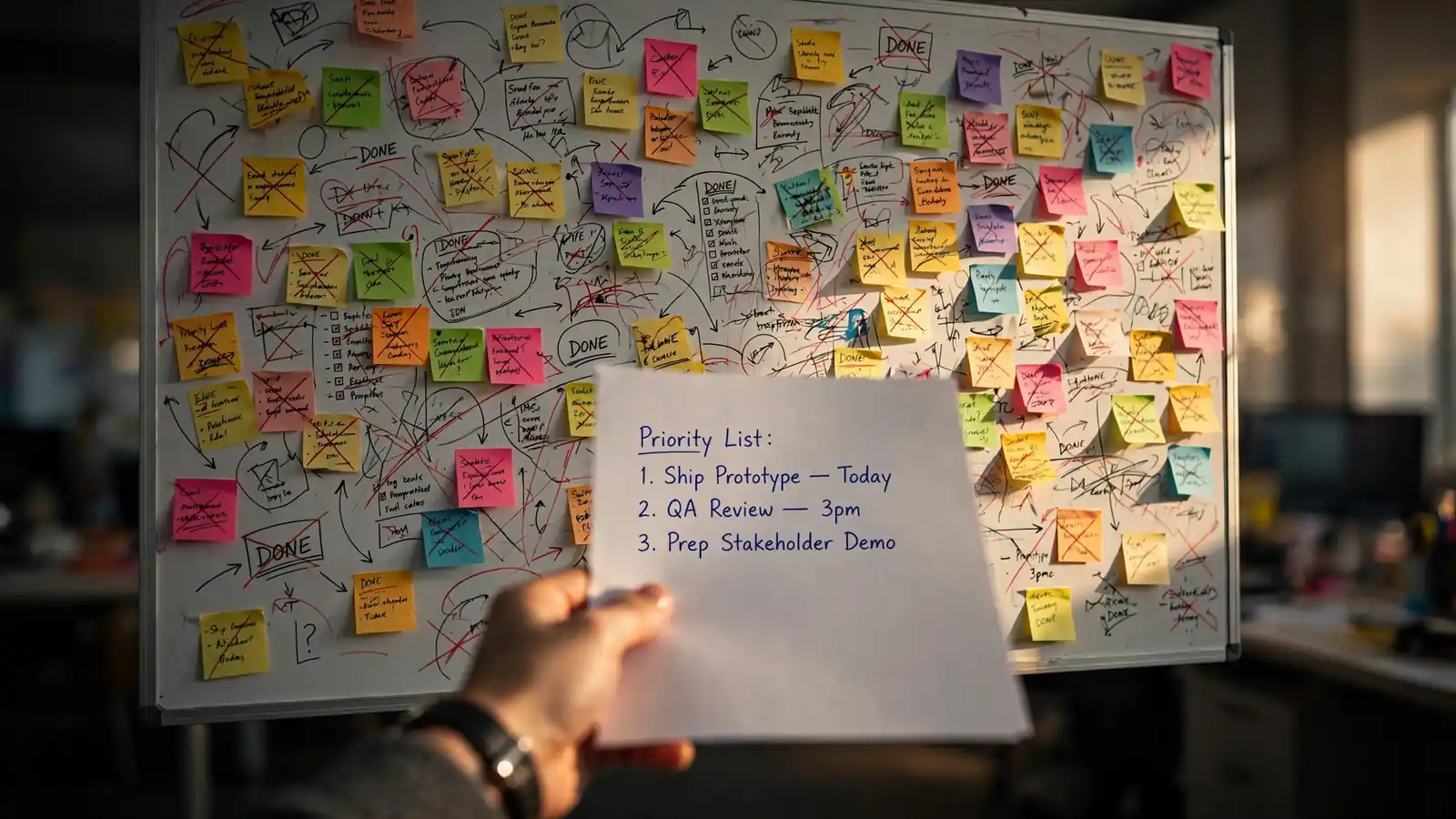
Prioritise ecommerce marketing by sequence, not by calendar. The order is: offer before traffic, conversion before scale, retention before acquisition. Each step makes the next one cheaper, so fixing things in order compounds while doing them out of order wastes spend. A real strategy names the three things that matter this quarter and explicitly kills everything else.
Open your Q4 marketing plan. Read it slowly. Now ask one question: if I showed this to a stranger, could they tell me what matters most?
If the answer is no, you do not have a strategy. You have a to-do list with dates. A very organised, colour-coded, shared-in-Slack way to stay busy. There is a campaign calendar, a content calendar, an email calendar, a promo calendar. Everything is scheduled. Nothing is prioritised. And at the end of the quarter, you will have done a lot and learned nothing, because doing was never the problem. Choosing was.
This is the most common failure mode in ecommerce marketing, and it hides in plain sight. The calendar looks like planning. It feels like planning. But a list of tasks wearing a timeline is still a list of tasks. Strategy is the part that says no.
Why your marketing calendar isn't a strategy
A strategy answers three questions. What is the goal, in numbers? What is the one mechanism that gets us there? What are we explicitly not doing? If your plan cannot answer all three on one page, it is not a strategy. It is a schedule.
Most marketing calendars fail the second question. They list activities: launch campaign, post daily, send newsletter, run sale. But activities are not mechanisms. A mechanism is a causal story: we will grow revenue 30% by lifting email from 10% to 25% of revenue, because our list is large, our flows are broken, and every point of email mix is worth $40k a month. That is a strategy. "Send two emails a week" is a task.
They fail the third question even harder. Real strategy requires killing things, and killing things requires someone with the authority to disappoint people. The founder wants TikTok. The agency wants a rebrand. The team wants a podcast. A to-do list says yes to all of it and schedules it. A strategy says: not this quarter, here is why, and here is the number we are chasing instead.
The cost of the to-do list is not just wasted effort. It is the opportunity cost of the mechanism you never built because you were busy with the calendar. Every week spent executing seventeen equal priorities is a week the compounding system did not get built.
The sequencing principle for ecommerce marketing
The alternative to the calendar is the sequence. It is a simple idea with uncomfortable implications: marketing activities have a correct order, and doing them out of order wastes money.
The order is offer before traffic. If the value proposition is fuzzy, the guarantee is weak, or the bundle makes no sense, every ad dollar costs more. Fix the offer and the same traffic converts better. Skip it and you buy expensive clicks for a page that cannot close.
Then conversion before scale. A site converting at 1% that doubles to 2% has doubled the value of every future visitor. That is true whether the visitor comes from ads, email or organic. CRO is unglamorous, it is hard to put on a calendar, and it is the highest ROI work in the building. One point of conversion on a $5M brand is $50k a year, found, not bought.
Then retention before acquisition. Thirty percent of revenue from email is normal for brands that build it properly. Most sit at ten. The gap is pure margin: customers you already paid to acquire, buying again, at near-zero cost. Acquisition scales the top of the funnel. Retention scales the bottom line. The calendar almost always overweights the former because acquisition is more visible.
Then content, then ads, then outreach. Content gives ads something worth amplifying. Ads give you data to sharpen the offer. Outreach scales what already works instead of gambling on what might.
Notice what the sequence does to prioritisation. It turns "what should we do this quarter?" from an opinion contest into a diagnostic. Where are we in the sequence? What is the weakest link? Fix that, then move on. The answer is never seventeen things. It is one thing, then the next.
What a real prioritised quarter looks like
Let me show you the difference concretely. Here is a to-do list quarter: refresh homepage, launch TikTok, A/B test checkout button colour, start a podcast, run Black Friday sale, post daily on Instagram, rebuild email flows, try influencer seeding, update packaging, launch loyalty programme.
Ten initiatives. Each gets a tenth of the attention. None gets finished properly. At the end of the quarter, the report lists activity and the revenue line is flat. Everyone is exhausted. Nobody knows what worked.
Here is a strategy quarter. Goal: grow revenue 25% by lifting email from 12% to 25% of revenue. Mechanism: rebuild the four core flows, launch a weekly campaign rhythm, grow the list with a better onsite capture. Explicitly not doing: TikTok, podcast, rebrand, loyalty programme. Three priorities. One owner each. Weekly check-in on one number: email revenue share.
The second quarter looks boring on a calendar. It will outperform the first by an embarrassing margin, because all the energy went into one compounding mechanism instead of being sprayed across ten. This is what prioritisation actually means: not ranking the to-do list, but shrinking it until the remaining items can each get the follow-through they need.
The hardest part is the killing. Every item you cut has a stakeholder. The founder read about TikTok. The agency pitched the rebrand. Saying no requires the one thing the to-do list never demands: a point of view about what matters. But that point of view is the entire job. Without it, you are not the head of growth. You are the head of scheduling.
How to run the sequence without burning out
The sequence tells you what to do. The remaining question is who does it, because a prioritised quarter still needs execution and you are still one person.
This is where the operating model matters as much as the strategy. The repetitive parts of each layer, the flow builds, the QA, the reporting, the monitoring, should run as systems, not as calendar items competing for your attention. When execution is systematised, your job narrows to the part only you can do: the point of view, the positioning calls, the creative direction.
A specialist SI bot team is built for exactly this shape of work. Software specialists led by a chief of staff bot, running the execution layers around the clock while you hold the strategy. The bots draft, you approve what goes out, and the quarter's three priorities get machine-speed follow-through instead of competing with seventeen tabs. The playbook behind it recorded 518% average sprint growth across client sprints.
The calendar will always try to creep back. New requests, new channels, new ideas from the founder's podcast queue. Your job, every Monday, is to hold the line: three priorities, one number, everything else waits. Strategy is not what you plan to do. It is what you refuse to do, defended weekly.
If your Q4 plan is currently a to-do list, start here. Shrink it to three things, sequence them properly, and watch what happens when all your energy finally points in one direction.
Start with the Growth Audit.
5 short questions. The SIBT team replies with your next step.
- 5 short questions
- Runs 24/7
- You pick approval or auto mode