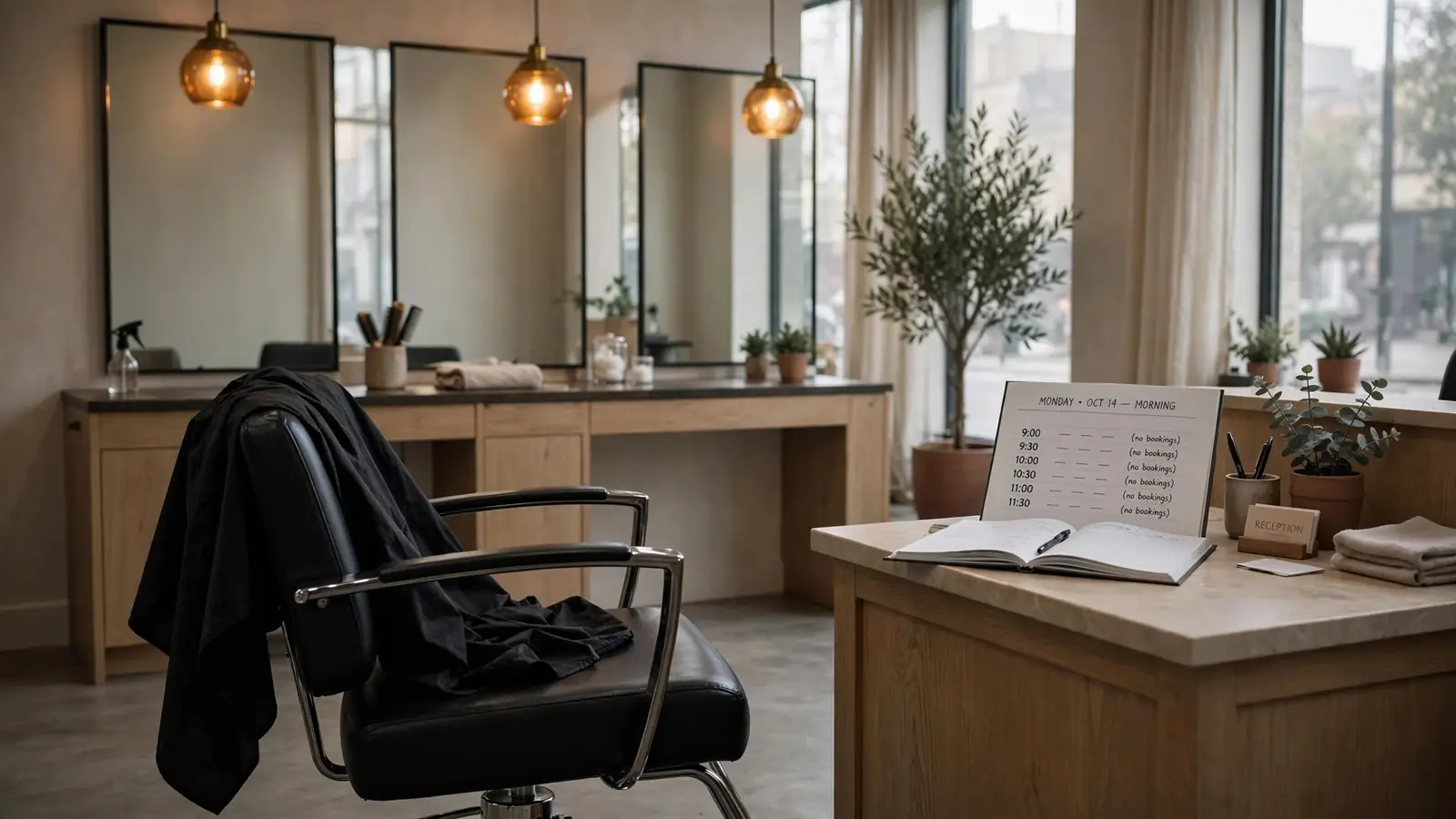
It is 2pm on a Thursday. The chair is empty. The client is not coming, and she is not going to call to tell you either. Your stylist stands around for 45 minutes. You lose the appointment, the retail sale that would have come with it, and the next appointment she would have booked if she had shown up.
Multiply that by every week, and the no-show is quietly one of the most expensive problems in your business. And here is the part nobody tells you: it is not your clients' fault. It is your system's fault, because you barely have one.
Why clients no-show (it's rarely rudeness)
When a client no-shows, the story owners tell themselves is about character: she is flaky, she does not respect my time, people are so rude these days. It feels true in the moment. It is almost never true.
Ask the clients themselves and you get a different story. She booked six weeks ago and forgot. The reminder never came, or came once and got buried. Her week changed and rescheduling felt like a phone call she did not have time for, so she did nothing. Life happened. Your appointment was one of forty things in her head, and it lost.
This is good news disguised as bad news. You cannot fix rudeness. You can absolutely fix forgetfulness. Every no-show that comes from a forgotten appointment is a system failure with a system solution, and the solution is three touches long.
The three-touch system
The salons with the lowest no-show rates all do the same three things. Not one of them. Not two. All three, every time, without exception.
Touch one: the confirmation text, 48 hours out. "Hi Sarah, confirming your cut and colour Thursday at 2pm. Reply YES to confirm or NO to reschedule." This is the workhorse. It catches the forgotten appointments while there is still time to fill the slot. A client who replies NO on Tuesday is a slot you can rebook. A client who simply never shows on Thursday is a hole in your day.
Touch two: the reminder, morning of. Short and warm: "See you at 2pm today!" This one is not really about information. It is about commitment. A client who has confirmed twice has mentally shown up already. The psychology is simple: people keep promises they have repeated.
Touch three: the rebooking prompt, at the chair. Before she leaves, while she loves her hair: "Shall I book your next one now? Six weeks?" This is the money touch, and we will come back to why in a moment.
Notice what is not on the list: deposits, cancellation fees, angry policies on Instagram. Those punish the symptom. The three touches prevent the disease.
The chair is where the money is
Of the three touches, the third one matters most, and it has nothing to do with no-shows. It is about the fact that a client sitting in your chair, happy with her hair, says yes to rebooking around 70% of the time. The same question sent by text a week later gets maybe 20%.
70% vs 20%
Rebooking at the chair vs by text a week later
Think about what that gap means. Every client who leaves without rebooking has a 50-point lower chance of coming back on schedule. Some drift to a competitor. Some just... stop. Not because they disliked you. Because nobody asked.
The question costs nothing. "Shall I book your next one now?" Eight words, asked at the moment of maximum goodwill. Salons that make it a non-negotiable part of every appointment do not have quiet months. They have a book that fills itself.
What no-shows cost you per month
Let us do the maths, because gut feel undersells it. Say you get 4 no-shows a week. That is conservative for a busy salon. At an $85 average ticket, that is $340 a week, or about $1,470 a month, walking out the door. Over a year: more than $17,000. And that counts only the lost appointment, not the retail sale, not the rebooking that never happened, not the empty chair your stylist stared at.
Now run the three touches against it. Cutting no-shows in half, which is what salons routinely report, puts roughly $8,000 a year back in your pocket. Not through new marketing. Not through working harder. Through texts that cost pennies and a question that costs nothing.
This is why no-shows are a systems problem. The money was always there. It was just leaking through the absence of three messages.
Should you charge no-show fees?
Every salon owner has considered it: a cancellation fee, a deposit, a card on file. It feels like the strong move. In practice, fees treat the symptom and poison the relationship. The client who forgot feels punished rather than reminded, and punished clients do not rebook. They leave reviews about your policy instead.
There is a narrower case where deposits make sense: very long appointments, like full colour corrections, where the cost of the empty slot is extreme. Even there, frame it as a booking deposit that comes off the service, not a penalty. "We take a $50 deposit to hold your three-hour slot, which comes straight off your bill." That reads as fair. A $50 no-show fee reads as hostile.
But notice: even the fair version is still weaker than prevention. A deposit does not fill the slot. The three touches do, because they stop the no-show from happening in the first place. Build the system first. Reach for fees never, or last.
See the full system for salons and service businesses
The three touches are the start. The full system also fills cancelled slots automatically, wins back clients who drifted away, and collects reviews from every happy customer. See how it fits together.
Making it run without you thinking about it
Here is where most salons stall. You read this, you agree with all of it, and then Tuesday happens: back-to-back clients, a colour correction running long, the phone ringing. The confirmation texts do not go out. The reminders do not go out. The rebooking question gets skipped "just this once." Within a month you are back to empty chairs and good intentions.
Systems that depend on memory are not systems. They are wishes. The three touches only work if they happen every time, for every client, without anyone having to remember. That means they need to run on their own: confirmations that send themselves 48 hours out, reminders that go out every morning, follow-ups that chase the clients who drifted.
SIBT builds what we call a specialist SI bot team for salons and service businesses. Forget the name. In plain English: it is the most reliable receptionist you will ever have. It confirms every appointment, reminds every client, rebooks at the right moment, fills the cancelled slots, and asks every happy customer for a review. It does it at 7am on a Monday and 11pm on a Sunday. It never forgets, never has an off day, and never leaves you with an empty chair that a text could have filled.
You do the hair. Let the system do the remembering. See exactly what it handles for a salon like yours, then count your no-shows last month and do the maths again. You already know what it is worth.